
Cut to keep the tree, not just to make it smaller.
Most trees don't need to come down — they need deadwood out, a heavy side balanced, or branches cleared off the roof and the service line. We thin and prune for health and clearance across Trumbull and Mahoning counties, cutting to the branch collar and taking only what the tree can spare.
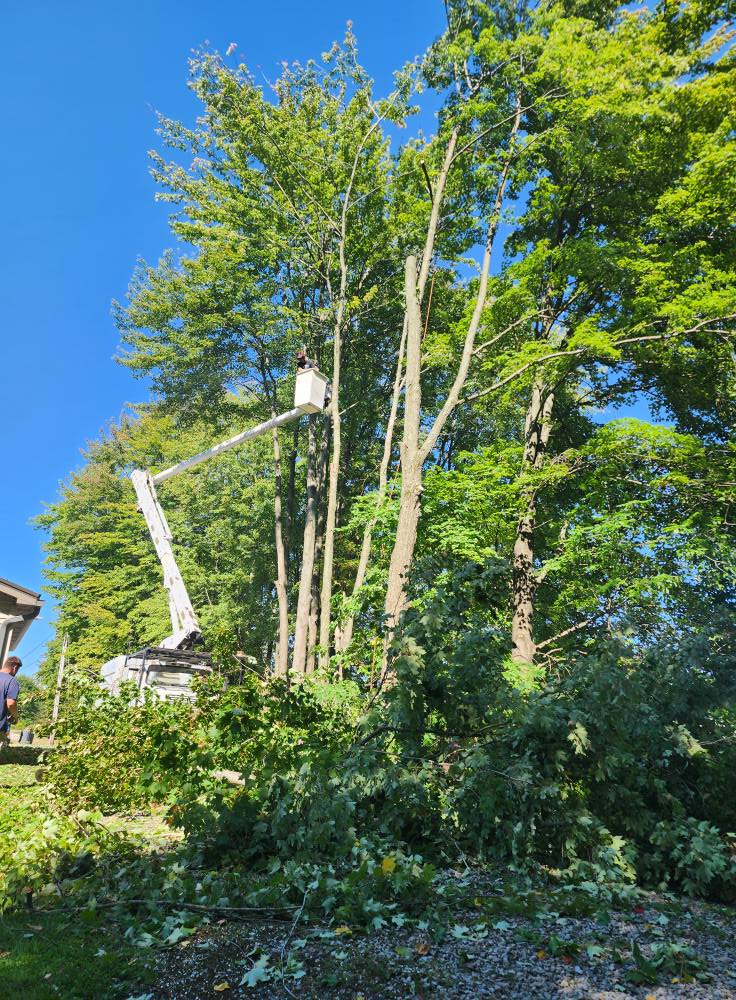
When a tree needs work, not removal
A lot of the calls we get are for trees that are perfectly healthy and just need attention. Deadwood hanging in the canopy is the big one — dead limbs don't ask permission before they fall, and they tend to come down on a calm afternoon onto whatever's below. Clearing it is the cheapest insurance there is.
Other times it's clearance: branches scraping the roof, blocking the driveway, growing into the service line from the pole to the house, or shading out the lawn. And sometimes a tree has gotten lopsided or top-heavy and wants thinning so wind passes through the crown instead of shoving against it. Each one is a different cut, and we make the right one.
What we don't do is top trees. Cutting a tree back to stubs is the fastest way to ruin it — it rots at the cuts and throws up weak, crowded regrowth that's more dangerous than what you started with. We prune to the branch collar, the way the tree heals, and leave it stronger than we found it.
Not sure if yours needs a trim or a takedown? That's what the free estimate is for. We walk it and tell you straight.
Old maples want thinning before the storms.
The big shade maples lining the older streets in Warren, Cortland, and Niles carry a lot of canopy, and a dense, top-heavy crown catches wind like a sail when a Mosquito Lake storm comes through. Thinning them ahead of the season is how you avoid the 6am call about a limb on the driveway. We work these neighborhoods every week and know how these trees move in weather.
Questions, answered
How often should trees be trimmed?
It depends on the tree and what you're after. Most mature shade trees do well with a structural prune every three to five years — enough to clear deadwood and keep the canopy balanced without stressing the tree. Fast growers near a roof or power line may need a look every couple of years. We'll tell you straight at the estimate whether yours needs work now or can wait.
What is crown thinning, and do I need it?
Crown thinning is selectively removing some of the inner and crossing branches so light and wind pass through the canopy instead of pushing against a solid wall of leaves. It eases the load on big limbs, cuts down on storm breakage, and lets more light reach the lawn and beds underneath. If your tree is dense, top-heavy, or dropping limbs in wind, thinning usually helps.
Can you trim branches near power lines?
We clear branches growing into the service line that runs from the pole to your house — that's the homeowner's side, and it's fair game. The high-voltage primary lines on the poles themselves belong to the utility; we don't touch those and you shouldn't either. If a tree is tangled in the primary, call the power company first. We work the service drop and anything overhanging the roof, drive, or yard.
Will trimming hurt or help the tree?
Done right, it helps — removing deadwood, weak crotches, and rubbing limbs makes a tree stronger and safer. Done wrong, it hurts: topping a tree or hacking it back to stubs invites rot and weak regrowth. We prune to the branch collar, take what the tree can spare, and leave the rest. The goal is a healthier tree, not just a smaller one.
More from the desk
Tree Removal
Safe takedowns of dead, dying, or hazard trees — yard trees to whole-lot clearing.
Read the department →Stump Grinding
Ground below grade so you can sod, plant, or just have your yard back.
Read the department →Storm & Emergency Work
Storm-down trees, blocked driveways, hung-up limbs — when weather wrecks your trees, we show up.
Read the department →Lot Clearing
Multi-tree clearing for builders, developers, and landowners. Crew, bucket truck, chipper, clean cleanup.
Read the department →Or head back to the front page, read the tree-care guide, or see where we work in Trumbull County and Mahoning County.
Trees getting shaggy?
Free estimate, a straight answer on what your trees actually need, and a clean yard when we leave. Storm-down trees: 24/7.