
Skip to content
The Bristolville Edition Bristolville, Ohio Family Owned · Fully Insured
1,000+ trees of experience Call Now · (330) 240-5839
Big Dogz

A Northeast Ohio tree-care guide.

What is growing in your yard, what is quietly trying to kill it, and how to tell a tree you can save from one that has to come down — written by a crew that works these two counties every week.

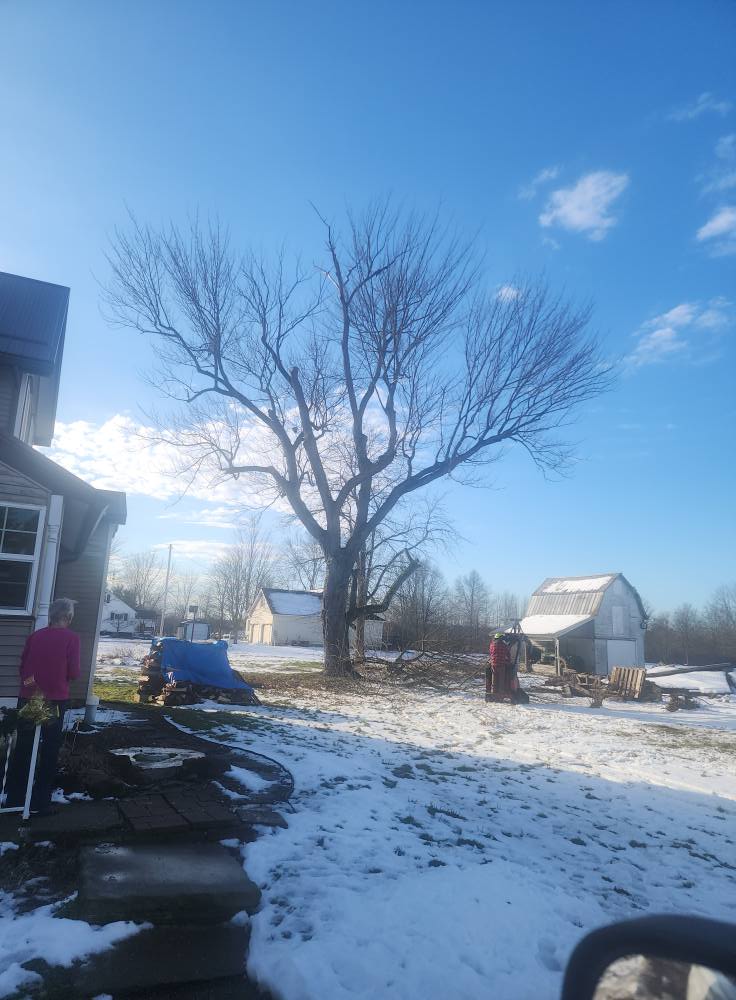
A large mature hardwood tree in a Northeast Ohio yard, the kind Big Dogz Tree Service inspects and cares for.
A mature yard tree in Trumbull County — strong from the road, but worth a closer look.
§ I

Know Your Trees

Common species · Habits & weaknesses

Most yards around here grew up with the same handful of trees — a lot of them planted in the 1950s and now well past their prime. Each one has its own habits and its own way of failing. Knowing which is which tells you a lot about what to watch for.

Silver Maple

Acer saccharinum

The fast grower people regret. Soft, brittle wood that splits in wind and ice, shallow roots that buckle sidewalks, and weak forks that tear out under their own weight. Common in older yards because it shot up quick. Worth watching closely as it ages.

Sugar Maple

Acer saccharum

The good maple — strong wood, the fall color everybody wants. Tougher than its silver cousin, but it still drops deadwood as it matures and resents having its roots disturbed by new construction.

Pin Oak

Quercus palustris

A street-tree favorite from decades back. Holds its lower limbs low and long, and it is a notorious limb-dropper — heavy horizontal branches let go in storms. Like all oaks, prune it only in winter to keep oak wilt out.

Red Oak

Quercus rubra

Big, fast for an oak, and a backbone of our woods. Strong overall, but it is the group most vulnerable to oak wilt, which can kill a healthy red oak in a single season. Never cut one in the warm months.

Ash

Fraxinus spp.

Effectively a standing hazard in our area now. Emerald ash borer has killed the vast majority of the region’s ash. A dead ash dries out and turns brittle fast — branches and whole tops come down with no warning. Dead standing ash near a house or drive should come down.

Sycamore

Platanus occidentalis

The big creek-bottom tree with the camouflage bark. Generally sturdy, but a cool, wet spring brings on anthracnose — leaves brown along the veins and the tree drops them early. It usually leafs out again; it looks worse than it is.

What’s Killing the Trees

Feature · Pests, disease & weather

Three things are taking down more trees in this part of Ohio than old age ever did — and two of them are nearly invisible until it is too late.

Emerald ash borer is the big one. The beetle arrived in Ohio years ago and has since reached every county in the state, ours included. It only goes after ash trees, and it is ruthless: the larvae tunnel under the bark and choke off the tree’s plumbing. A green or white ash usually dies within three to six years of being infested.

The reason a dead ash is so dangerous is what happens after it dies. The wood dries out and turns brittle in a hurry. Branches snap, tops break off, and whole trees come down with no wind to speak of. We have taken down hundreds of standing-dead ash in Trumbull and Mahoning, and almost every one was a hazard waiting for a windy night.

Oak wilt is the quieter threat. It is a fungus that moves through the red and black oak group, and it can kill a big, healthy red oak in a single summer — the canopy browns from the top down and the leaves drop early. It spreads two ways: underground through connected roots, and above ground when sap beetles carry it to fresh cuts. That is why the timing of an oak pruning matters so much.

Then there is the weather. The storms that roll through here hit harder than they used to, and they find the weak trees first — the brittle silver maples, the low-forked pin oaks, the dead ash nobody got around to taking down. A tree that was fine for forty years can come apart in one bad August afternoon.

None of this means every tree is doomed. Healthy oaks pruned in the dead of winter stay healthy. Ash can sometimes be treated if you catch it early enough and the tree is worth it. But the trees planted when these neighborhoods were new are tired, and the threats are real. The move is to look before the storm does.

“A dead ash is not a tree anymore. It is a brittle pole that will come down on its own schedule — usually the worst one.”
§ II

Is It a Hazard?

Six things to walk your trees for

You do not need to be an arborist to spot a tree in trouble. Walk your trees once a season — especially the big ones near the house, the driveway, and anywhere people stand — and look for these six signs. Any one of them near something you care about is worth a closer look.

01

Dead limbs in the crown

Bare branches with no buds while the rest of the tree is green. Over a roof, a drive, or a play set, these are the first things to come down in a storm.

02

A hollow or soft trunk

If you can push a screwdriver into the wood, or there is an open cavity, the trunk has lost the strength that holds the tree up.

03

A new lean

A lean that wasn’t there last year — especially with soil cracking or lifting on the high side — means the roots are letting go. That is the urgent one.

04

Root heave

Ground bulging or cracking in an arc around the base. The root plate is starting to pull out of the ground.

05

Cracks and cankers

Deep vertical cracks, or sunken dead patches (cankers) in the bark, are weak points where the trunk or a major limb can split.

06

Fungus at the base

Mushrooms or hard shelf-fungus growing on the trunk or root flare almost always mean rot is already inside the wood you can’t see.

Is my tree dead or just dormant? In late spring, scratch a twig with your thumbnail — green and moist under the bark means it is alive; brown and dry means that branch is dead. If the whole crown fails to leaf out by June while everything around it is green, the tree is most likely dead, not late.

Save It, or Take It Down?

Our bias · We’d rather save your tree

Here is the part most tree companies skip: we would genuinely rather save your tree than cut it down. A healthy tree is worth money and shade and forty years you can’t buy back. Removal is the last call, not the first. Most of the time the question is which of these two columns a tree falls into.

Often saved
  • A few dead limbs, sound trunk. Deadwood comes out, the rest of the tree is fine. This is routine pruning, not removal.
  • A heavy or split-prone fork. A cable or brace can hold a weak union together for years and keep a good tree standing.
  • Crowding and poor shape. Crown thinning lets light and wind through, takes weight off long limbs, and improves the tree’s health.
  • Limbs into the house or lines. Clearance pruning solves the problem without losing the tree.
  • Storm damage to branches only. If the trunk and roots are sound, a damaged crown can often be cleaned up and recover.
Has to come down
  • A hollow or rotted trunk. Once the structural wood is gone, there is nothing to prune back to. The tree can’t hold itself up.
  • Dead standing ash. Brittle, unpredictable, and a falling hazard. These are not worth saving once the borer has won.
  • A fresh lean with root heave. The roots are already failing. This is the one that comes down on its own if you wait.
  • More than half the canopy dead. Past a certain point the tree can’t recover, and what’s left is a hazard.
  • Right tree, wrong place. Sometimes a healthy tree is simply too close to the foundation, the septic, or the lines to stay.
“We’d rather save your tree. When we can’t, we’ll tell you straight, and it’ll be down and cleaned up by the end of the day.”
§ III

The Tree-Care Calendar

When to trim · What to do after a storm

Best time to trim

For most trees around here, late winter — December through March, while the tree is dormant — is the sweet spot. The structure is easy to read with the leaves off, the cuts seal cleanly come spring, and most pests and diseases are asleep.

Oaks are the exception that matters. Prune oaks only in winter, roughly mid-November through March. A fresh cut on an oak in the warm months is an open invitation to oak wilt — the sap beetles that spread it are out and looking for exactly that wound. If an oak has to be cut in summer after storm damage, the wound gets sealed the same day.

After a storm

Stay clear and assume every downed line is live. Never touch a tree or limb that is resting on a power line, and keep kids and pets away from anything leaning or hung up.

A limb caught in the canopy — a widow-maker — a split trunk, or a tree on the house, the car, or the drive is a job for a crew with rigging and a bucket truck, not a ladder and a homeowner saw. Take photos for your insurance before anything moves, then call. Our storm line runs 24/7 for exactly this — we answer when the lights are out.

§ IV

Questions We Get Asked

Straight answers · No upsell
What are the signs a tree needs to be removed?

A tree usually has to come down when the trunk is hollow or soft, when more than about half the canopy is dead, when there is a fresh lean with soil heaving or cracking at the base, or when there is a large vertical crack or a cavity where two main stems meet. Mushrooms or shelf fungus growing at the base of the trunk are a bad sign too — they mean the roots or the lower trunk are already rotting. One dead limb is a pruning job. A failing root system or a rotten trunk is a removal.

Is my tree dead or just dormant?

In late spring, scratch a small spot of bark on a twig with your thumbnail. Green and moist underneath means the wood is still alive; brown, dry, and brittle means that branch is dead. Do a few twigs around the tree. If the whole crown fails to leaf out by late May or June when everything around it is green, the tree is most likely dead, not late. Bare branches in January tell you nothing — that is just winter.

What are the signs of emerald ash borer in Ohio?

Emerald ash borer only attacks ash trees. Watch for thinning at the very top of the canopy, lots of new shoots sprouting straight out of the trunk (the tree trying to save itself), D-shaped exit holes about an eighth of an inch wide in the bark, and woodpeckers stripping the bark to get at the larvae — that "blonding" of the trunk is often the first thing people notice. By the time the top is bare, the tree is usually too far gone to save and becomes a brittle hazard that fails fast. Emerald ash borer has reached every county in Ohio, including ours.

When should I trim my trees?

For most trees in our area, late winter — roughly December through March, while the tree is dormant — is the best time to prune. The structure is easy to read with no leaves, the cuts heal cleanly in spring, and most insects and diseases are inactive. Oaks are the big exception: prune oaks only in winter (mid-November through March) to avoid oak wilt, which spreads through fresh cuts in the warm months. Storm-damaged or clearly hazardous limbs are the one thing you handle any time of year — safety comes before the calendar.

What do I do with a storm-damaged tree?

First, stay away from it and keep everyone clear — never touch a limb or trunk resting on a power line, and treat any line on the ground as live. If a tree is on your house, car, or driveway, a hanging "widow-maker" limb is caught up in the canopy, or the trunk has split, that is a job for a crew with the right rigging, not a ladder and a homeowner saw. Take photos for your insurance before anything is moved, then call. We run a 24/7 storm line for exactly this.

How do I know if a tree is dangerous?

Walk the tree and look for the warning signs: dead limbs over a house, driveway, or play area; a hollow or soft spot you can push a screwdriver into; a lean that appeared recently, especially with cracked or lifting soil on the high side; deep cracks or sunken cankers in the trunk; and mushrooms or fungus at the base. A tree with any of those near a target — a house, a car, a place people stand — should be looked at before the next storm, not after. When you are not sure, our estimates are free; we would rather tell you it is fine than have you wonder.

Free Estimates · No Pressure

Not sure about a tree? Have us take a look.

Reading about it only gets you so far. If a tree near your house has you wondering, we will come out, walk it with you, and give you a free, honest estimate — even if the answer is “leave it alone.” Storm-down trees: call any time.

(330) 240-5839
Mon–Fri · 9am – 5pm ET · Storm line, anytime
Call (330) 240-5839
Call the Desk · (330) 240-5839
Phone copied to clipboard